
All-Inclusive Vacations in the United States for Families vs. the Caribbean: Which Is Better for Your Crew?

Families comparing all-inclusive vacations in the United States for families with Caribbean resorts are evaluating two different vacation models.
U.S. properties usually provide simpler transportation, domestic travel requirements, and familiar services. Caribbean resorts usually provide more standardized all-inclusive coverage, larger resort campuses, and more extensive beach amenities.
The correct choice depends on total trip cost, travel documents, children’s ages, desired activities, and tolerance for logistics.
Cost: Domestic pricing is simpler. Caribbean pricing is more comprehensive.
A U.S. all-inclusive vacation may use a room-based rate, a meal plan, or an inclusive package. A Caribbean resort generally uses a per-person rate that includes lodging, meals, drinks, and many resort activities.
For a family of four, broad planning ranges can look like this:
| Cost category | United States | Caribbean |
|---|---|---|
| Seven-night resort stay | Approximately $2,000–$8,500, depending on property and season | Approximately $4,200–$11,200 for budget to mid-range properties |
| Airfare | Often lower or unnecessary for drive-to resorts | Commonly an additional $1,200–$3,000 or more for four travelers |
| Passports | Not required for mainland U.S. travel | Required for most foreign Caribbean destinations |
| Transfers | Rental car, rideshare, or domestic transfer | Airport transfer usually required; shared or private options vary |
| Activities | May be included or separately priced | Many non-motorized activities are included; excursions usually cost extra |
These figures are planning ranges, not guaranteed prices. School holidays, room configuration, departure airport, promotions, and resort category produce substantial variation.
A domestic trip can produce the lower total cost when the family can drive to the property. This is particularly relevant in the Northeast, where Pennsylvania, New York, Vermont, and New England resorts can eliminate airfare.
A Caribbean trip can provide stronger value when the family is departing from Florida or the Southeast, already has passports, and expects to use the included dining and activities throughout the stay.
What is included and what remains extra?
U.S. all-inclusive resorts
The primary issue in the United States is terminology. “All-inclusive” does not have one universal definition.
Some properties include lodging, meals, snacks, entertainment, and most activities. Others provide a meal plan, resort credit, attraction tickets, or a package with limited inclusions.
Examples include:
- voco Sandpiper All-Inclusive Resort in Port St. Lucie, Florida. Its package includes dining, house cocktails, daily activities, live entertainment, pools, sports, and family amenities.
- The Pines at Woodloch, a family resort in Pennsylvania. Traditional packages include two or three meals daily, accommodations, more than 30 daily activities, resort amenities, and entertainment.
- Rocking Horse Ranch in Highland, New York. Included activities include horseback riding, indoor water park access, family activities, entertainment, meals, tastings, and snacks.
- Tyler Place Family Resort in Vermont. Packages include meals, sports, activities, facilities, entertainment, and age-specific infant, toddler, children’s, and teen programs.
- Florida Keys properties such as Isla Bella Beach Resort may offer all-inclusive dining packages without including every activity or service.

Common U.S. extras include airport transportation, premium alcoholic beverages, spa treatments, off-site excursions, specialty dining, attraction tickets, and equipment rentals. Confirm each item before booking.
Caribbean all-inclusive resorts
Caribbean packages more commonly include:
- Accommodation
- Breakfast, lunch, dinner, and snacks
- Non-alcoholic beverages and selected alcoholic beverages
- Pools and beach access
- Daily activities
- Non-motorized water sports
- Kids’ clubs and teen programming at qualifying resorts
- Nightly entertainment
- Resort taxes and gratuities at many properties
- Airport transfers under select promotions or booking conditions
Common extras include airfare, travel insurance, excursions, spa treatments, private transfers, cabanas, premium liquor, motorized water sports, babysitting, and specialty culinary experiences.
The inclusion list must be checked at the room-category level. A premium club upgrade may change restaurant access, transfer terms, room service, beach areas, and reservation priority.
Flight time, passports, and transfer logistics
Domestic travel is the simplest category for families with young children or travelers without current passports.
U.S. citizens generally do not need passports for mainland destinations, Puerto Rico, or the U.S. Virgin Islands. Adults flying domestically need a REAL ID-compliant identification document or another acceptable form of identification. Children under 18 typically do not need identification for domestic flights, although carrying a birth certificate is practical.
Foreign Caribbean destinations require more documentation. Each traveler, including each child and infant, generally needs an individual valid U.S. passport book for international air travel. A passport card is not valid for international air travel. Many destinations also require validity beyond the return date.
Review current requirements through the U.S. Department of State passport guidance and the destination-specific country page before purchasing tickets.
Transfer logistics also differ. A U.S. resort may require a rental car or a short rideshare trip. A Caribbean resort usually requires a coordinated airport transfer. Shared transfers reduce cost but may include multiple resort stops. Private transfers cost more but reduce waiting time.
For example, Royalton Punta Cana is approximately 25 to 30 minutes from Punta Cana International Airport. The resort advertises complimentary round-trip transfers under specific offers and booking conditions. Those conditions should be confirmed before final payment.
Resort size and amenities
U.S. family properties are often smaller and more activity-focused. The resort may be located inland, beside a lake, in the mountains, or along a river rather than directly on a major beach.
This structure can be useful for families that prefer:
- Shorter distances between rooms and activities
- Lower-key dining operations
- Organized schedules
- Drive-to access
- Seasonal experiences such as skiing, leaf viewing, or outdoor recreation
- Familiar medical and retail infrastructure
Florida provides the strongest concentration of true or near-all-inclusive U.S. options. The Southeast offers family packages in destinations such as Myrtle Beach, Gatlinburg, and Williamsburg. Texas and the Northeast have fewer classic all-inclusive resorts, although full-board ranches, lake resorts, and family packages are available.
Caribbean properties are more likely to be large destination resorts. A single property may include multiple pools, several restaurants, children’s zones, water parks, beach service, sports facilities, entertainment venues, and adjoining sister resorts.
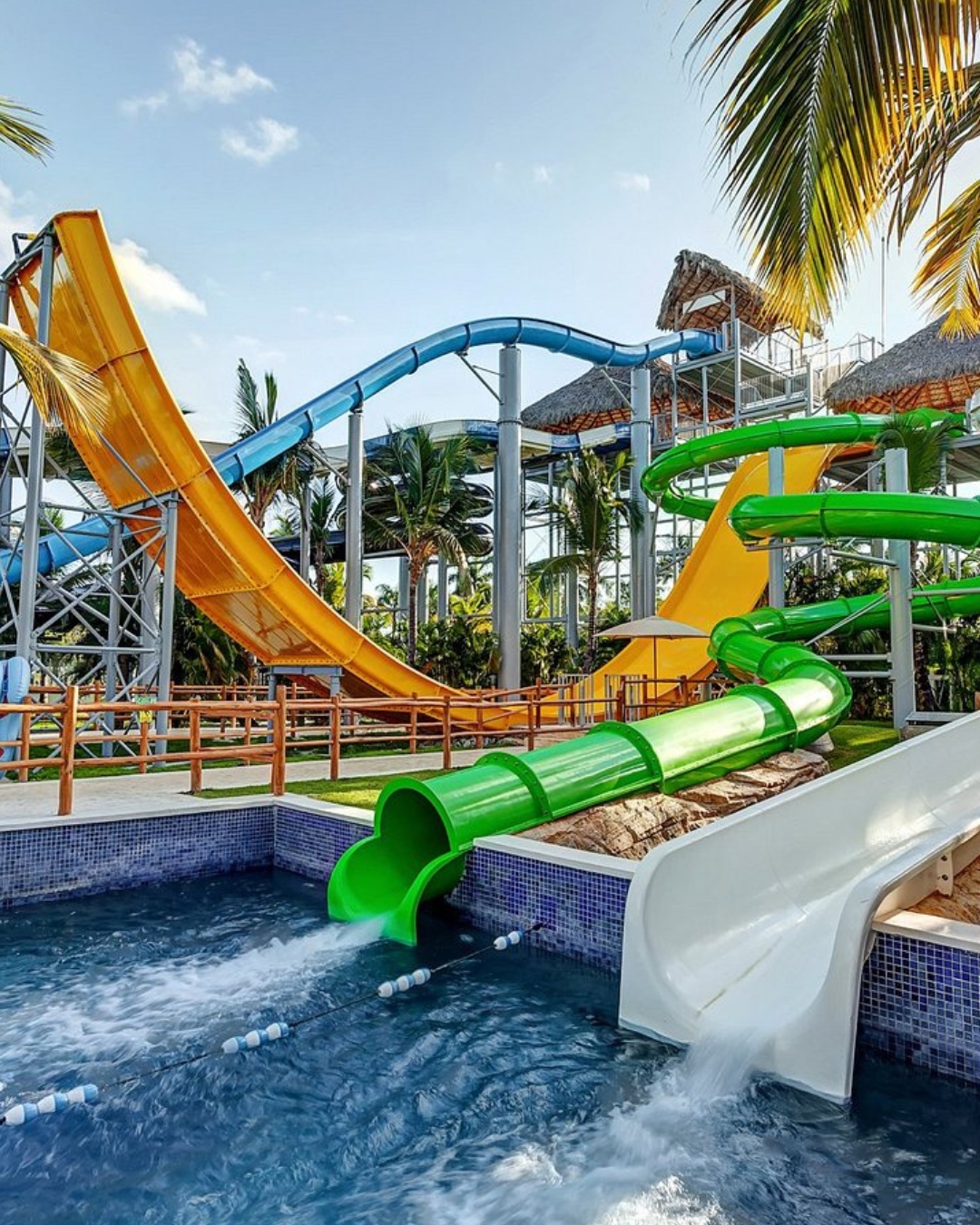
Royalton Punta Cana, for example, lists 11 restaurants, 13 bars, pools, tennis, a kids’ club, a teen club, nightly entertainment, and access to a neighboring water park.
Large resorts create more choice. They also create more walking, more transportation within the property, and more potential for crowded central areas.
Food and dining
U.S. resorts usually provide familiar menus, standard allergy communication, and easier access to grocery stores or pharmacies. Woodloch offers two or three included meals daily. Rocking Horse Ranch advertises all-you-can-eat meals, tastings, and snacks.
The limitation is dining variety. Some U.S. properties operate one primary dining room or a small number of restaurants. Meal schedules may be fixed.
Caribbean resorts generally provide buffets, snack bars, casual restaurants, and several à la carte venues. Royalton Punta Cana lists Italian, Caribbean, buffet, and other international dining options. Beaches Resorts in Turks & Caicos and Negril provide multiple restaurants and bars.
Specialty restaurants may require reservations. Some premium venues, chef’s tables, wine pairings, and upgraded beverages remain outside the base package.
Families should verify:
- Number of included meals per day.
- Restaurant operating hours.
- Reservation requirements.
- Children’s menus.
- Allergy and dietary procedures.
- Whether room service and minibars are included.
- Whether premium dining requires an upgrade.
Kids’ clubs and teen programming
U.S. resorts often perform well in structured age-based programming.
Tyler Place provides separate infant, toddler, children’s, and teen camp programs. Rocking Horse Ranch provides broad activities for multiple age groups, including horseback riding, water activities, sports, and nightly entertainment.
Caribbean resorts more frequently provide dedicated facilities with extended schedules. Beaches Resorts lists supervised teen activities, game rooms, water sports, a teen nightclub, mocktails, and water parks. Royalton Punta Cana lists supervised programming for children ages 4–12 and a separate teen club with video games, sports, and social areas.
Verify the following before booking:
- Minimum and maximum ages
- Operating hours
- Staff-to-child ratios
- Check-in and check-out procedures
- Evening programming
- Babysitting fees
- Whether children must be toilet-trained
- Whether teen activities are supervised
- Whether programs are available at the selected resort or only a sister property
Beaches, weather, and hurricane-season timing
The Caribbean has warmer conditions throughout the year and generally offers more direct access to tropical beaches, clear water, snorkeling, and non-motorized water sports.
Florida, the Southeast, and the Texas Gulf Coast provide beach access but have greater variation in water temperature, humidity, sea conditions, and seasonal weather. The Northeast has strong summer beach conditions but is not a year-round tropical destination.
The official Atlantic hurricane season runs from June 1 through November 30. The statistical peak occurs around September 10, with the highest activity generally occurring from mid-August through mid-October. This applies to the Caribbean, Florida, the Southeast coast, and the Gulf Coast.
Inland U.S. resorts in Pennsylvania, New York, and Vermont avoid coastal hurricane exposure. Caribbean and coastal U.S. trips during hurricane season may offer lower rates, but weather disruptions remain possible.
Families traveling during this period should review travel insurance, resort cancellation rules, airline policies, and weather-related rebooking procedures. The National Hurricane Center provides official seasonal information.
Safety and convenience
The United States offers domestic legal systems, familiar healthcare access, easier communication, and fewer border procedures. This reduces administrative complexity.
Caribbean resorts operate with established security, medical procedures, and transportation networks. However, conditions vary by destination and property. Off-site excursions require separate review. Families should use authorized transfers, follow resort transportation guidance, and consult current government travel advisories.
Convenience depends on the family’s priorities. A drive-to resort may be operationally easier than a short international flight if passports are unavailable. A Caribbean resort may be more convenient after arrival because meals, activities, entertainment, and transfers can be bundled.
Who should choose each option?
Select a U.S. all-inclusive vacation if:
- The family does not have passports.
- The trip must be drive-to or short-haul.
- The children are very young.
- Domestic healthcare and familiar food service are priorities.
- The family wants a structured camp, ranch, mountain, or lake experience.
- Travel occurs during peak hurricane months and an inland destination is preferred.
- The family wants a smaller property with fewer internal logistics.
Select a Caribbean all-inclusive vacation if:
- The family wants a tropical beach as the primary setting.
- Passports are current for every traveler.
- Kids’ clubs and teen programming are essential.
- The group wants multiple pools, restaurants, and water activities.
- The family is departing from Florida or the Southeast.
- The value of bundled food, drinks, entertainment, and activities outweighs the airfare.
Verdict: Which is better for your crew?
There is no universal winner.
Choose the United States when documentation, drive-to access, predictable domestic logistics, and structured family programming are the controlling factors.
Choose the Caribbean when beach quality, resort scale, dining variety, teen facilities, and broader all-inclusive coverage are the controlling factors.
Before booking, compare the complete trip total. Verify every inclusion. Confirm transfer terms. Check passport validity. Review hurricane-season policies. Evaluate kids’ club hours against the children’s ages.
Questique Travel by Dream Vacations provides advisor-led planning for both resort and cruise vacations. Our team compares current offers, room categories, inclusions, transfer logistics, and destination requirements. We also work across resort brands such as Sandals and cruise lines ranging from mainstream to luxury. Planning support continues from the initial booking through the return home.
Speak with Questique Travel to compare current all-inclusive family vacation packages in the United States and the Caribbean.